LLMO for Earnings Reports: How to Make Financial Content Easy for AI Copilots to Cite
AI copilots are quickly becoming the default way many people digest earnings reports. Instead of reading a 60-page PDF end-to-end, investors ask questions like:
- “What drove margin expansion this quarter?”
- “How did guidance change vs last quarter?”
- “What’s the biggest risk called out in the filing?”
Tools like Reporto can summarize and explain earnings faster—but there’s a catch: AI outputs are only as reliable as the inputs they can cleanly read, retrieve, and quote.
That’s where LLMO (Large Language Model Optimization) comes in: optimizing your content so AI systems can accurately understand it, extract the right facts, and reference it in answers.
This post is a practical checklist for founders, IR teams, and analysts who publish financial content (earnings pages, shareholder letters, investor decks, FAQs) and want that content to be AI-readable, quoteable, and harder to misinterpret.
1) Start with a single “source of truth” (don’t make the PDF the only source)
PDFs are common, but they’re not always the best format for precise extraction—especially when important numbers live in tables, footnotes, or images.
Do this:
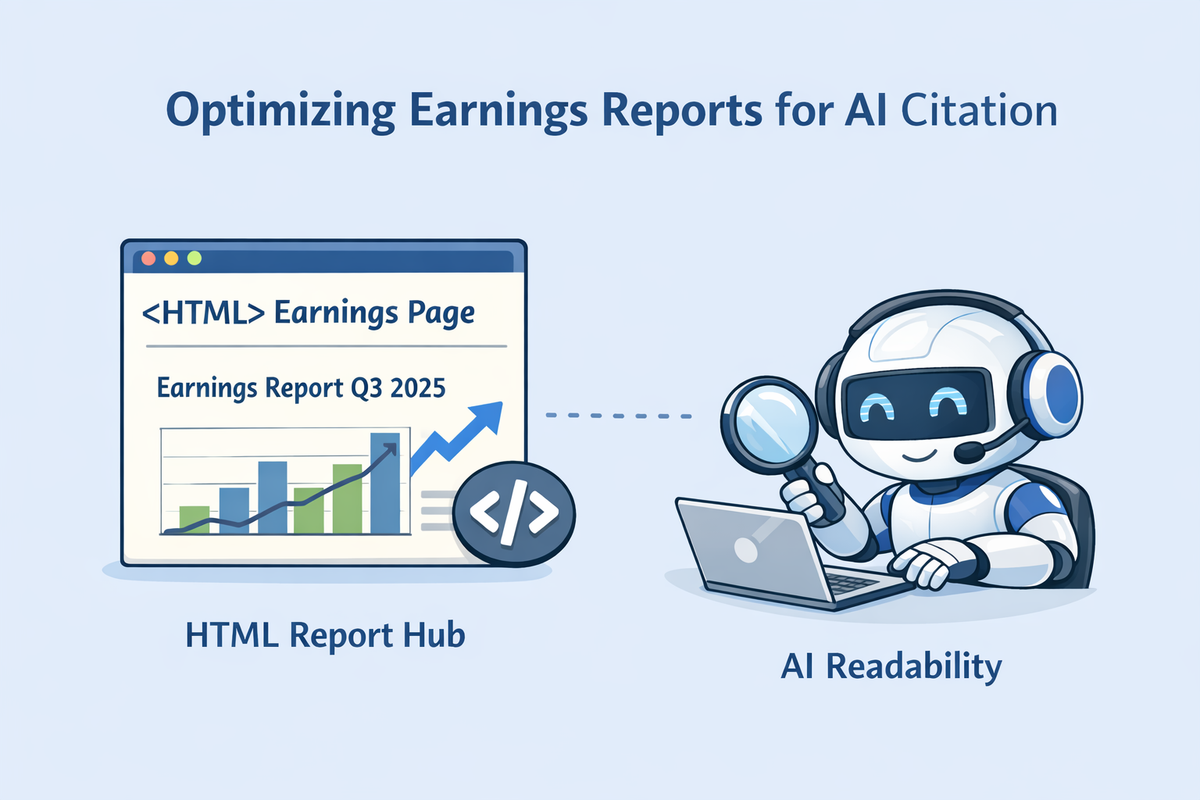
- Publish a canonical earnings page (HTML) for each quarter/year.
- Keep the PDF available, but treat the web page as the reference hub.
- Put the “top facts” directly on the page in plain text (not embedded in images).
Why it helps: AI systems (and people) can quote clean text much more reliably than screenshots or chart images.
2) Write “quoteable facts” (one metric per sentence, with units + timeframe)
A common failure mode: AI mixes up periods, units, or denominators.
Instead of:
“Revenue grew strongly and margins improved.”
Write:
“Q3 2025 revenue was $X, up Y% YoY. Gross margin was Z%, up A bps QoQ.”
Simple rule: Every key number should carry context: timeframe, unit, and comparison baseline.
3) Add a “Key Metrics” block that looks great in plain text
Put this near the top of your earnings page or blog post.
Example (adjust to your needs):
| Metric | This Quarter | Prior Quarter | YoY |
|---|---|---|---|
| Revenue | $X | $Y | +Z% |
| Gross Margin | A% | B% | +C bps |
| Operating Income | $M | $N | +P% |
| Free Cash Flow | $U | $V | -W% |
Why it helps: This is the kind of structure AI can lift directly without “creative interpretation.”
4) Define your terms like you’re training a new analyst
If you use company-specific terms (segments, products, KPIs), add a short glossary.
Good glossary entries are short and unambiguous:
- “Adjusted EBITDA”: EBITDA excluding X, Y, Z (link to reconciliation if available)
- “Active Customers”: unique paying accounts with at least 1 transaction in the last 30 days
- “North America Segment”: includes US + Canada revenue only (excludes LATAM)
Why it helps: Definitions reduce hallucinations and mismatched interpretations.
5) Add an Earnings FAQ (this is LLMO gold)
AI systems love Q&A because it mirrors how users ask.
Include 8–12 questions you expect investors to ask:
- What drove revenue change this quarter?
- What changed in guidance and why?
- What are the top 3 risks for the next 2 quarters?
- What’s the biggest expense driver?
- Any one-time items impacting EPS/FCF?
- Which segments grew fastest?
Keep answers short, factual, and consistent with your “Key Metrics” block.
6) Consider publishing an /llms.txt (optional, experimental)
An emerging practice in LLMO/GEO is adding an /llms.txt file—basically a curated, markdown-style “map” of your most important content for AI consumption. It’s still early and not universally adopted, but it’s gaining attention.
If you do this, keep it clean:
- Link to your earnings hub
- Link to glossary/definitions
- Link to KPI methodology
- Link to press releases / filings / investor decks
7) Make credibility easy to verify (reduce “AI confidence errors”)
When content is ambiguous, AI will often “fill in the blanks.” Help it stay grounded:
- Use clear author attribution (name, role, date)
- Include primary sources (filing, deck, transcript) where appropriate
- Keep archived quarters accessible (don’t break links)
For public-company content, stability matters: dead links and changing URLs are a reliability killer.
The Quick Checklist (copy/paste)
Before publishing an earnings post/page:
- Canonical earnings page (HTML) exists
- “Key Metrics” block in plain text
- Every metric includes timeframe + unit + baseline
- Clear definitions for KPIs and segment names
- 8–12 question Earnings FAQ
- Sources linked or cited where relevant
- (Optional) /llms.txt published and updated
Resources
If you’re actively working on LLMO (templates, checklists, and practical implementation notes), I built a small site to organize what I’m testing and learning: https://llmoai.net/
Disclosure: I’m the creator of the site above.
Disclaimer
This post is for informational purposes only and is not financial advice. Always verify numbers against primary filings and official company communications.